
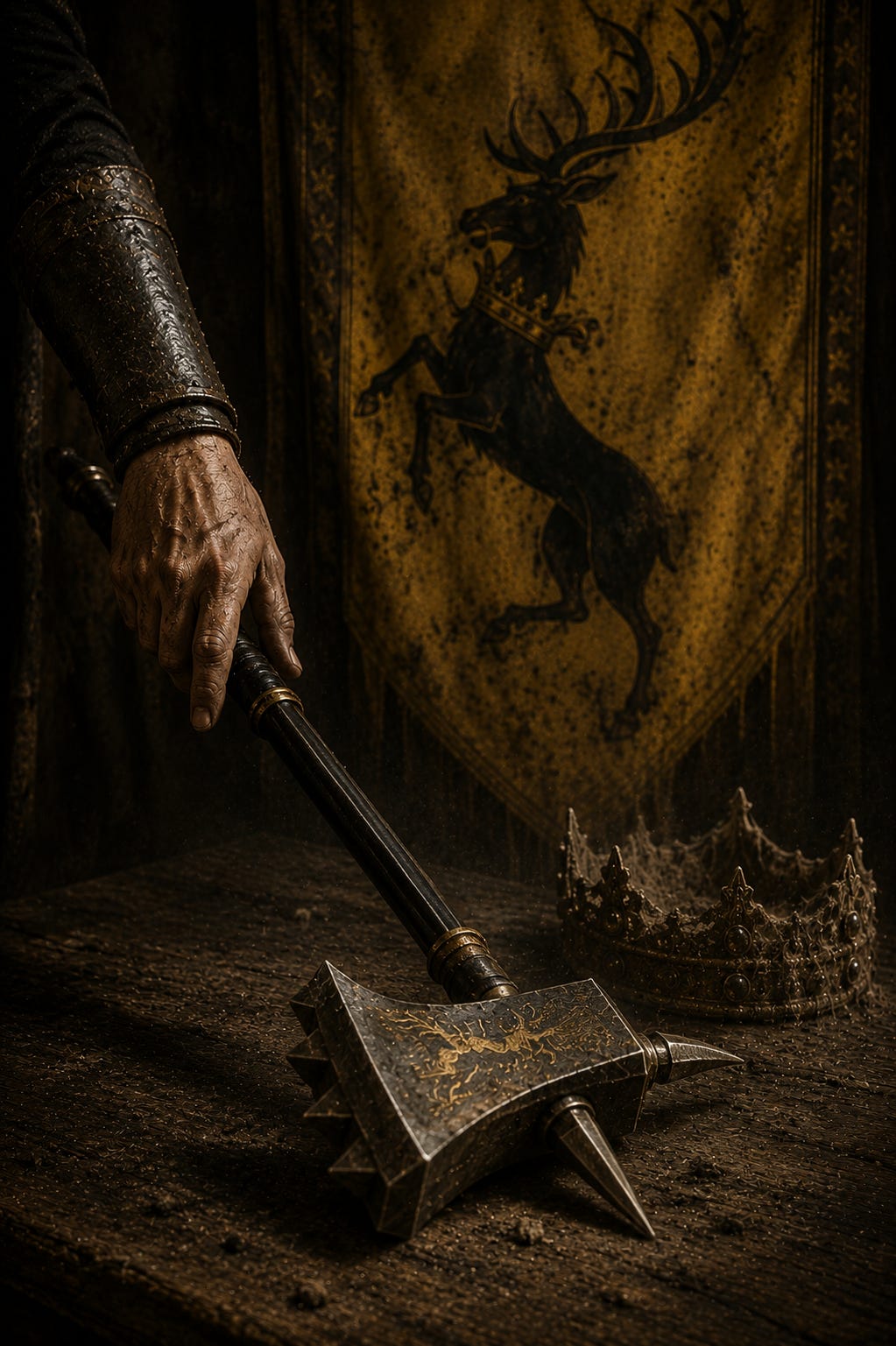
Whenever the name Robert Baratheon is mentioned, most fans of A Song of Ice and Fire immediately remember an irresponsible king, a man who spent his days drinking, hunting, feasting, and bedding whores while allowing the kingdom to drift toward ruin. By the time the story begins, that image is certainly accurate.
But Robert Baratheon did not begin his story as the fat, drunken king we meet in A Game of Thrones. To understand Robert, we must first understand how he became king, because Robert was never a man who sought the Iron throne.
For over three centuries, ever since Aegon the Conqueror united the Seven Kingdoms, House Targaryen had ruled Westeros. Their reign endured for nearly three hundred years until the madness of King Aerys II Targaryen the Mad King brought the dynasty to the brink of destruction. Aerys’ descent into paranoia changed the course of history. When Brandon Stark rode to King’s Landing demanding justice for the alleged kidnapping of his sister Lyanna by Prince Rhaegar Targaryen, the Mad King arrested him. Lord Rickard Stark, Brandon’s father, came south expecting a trial by combat. Instead, Aerys had Rickard burned alive while Brandon strangled himself trying desperately to save him.
Not satisfied with murdering the Lord of Winterfell and his heir, Aerys demanded that Jon Arryn, Lord of the Eyrie, surrender the heads of his two wards: Eddard Stark and Robert Baratheon. Jon Arryn refused. With this act of defiance, the rebellion began.
At the outbreak of the war, Robert had never commanded an army nor fought a major battle. Yet almost immediately he proved himself to be one of the greatest battlefield commanders of his generation. He raised the banners of the Stormlands while Jon Arryn rallied the Vale and Ned Stark called the North.
Robert’s first great test came at the Battle of Summerhall, where he defeated three loyalist armies that attempted to converge upon him. Fighting with his legendary warhammer, Robert personally slew Lord Fell, while Lords Grandison and Cafferen fell in the fighting. It was an astonishing victory that established him as far more than a rebellious lord. Throughout the war he continued to build his legend, winning battle after battle and earning the loyalty of thousands through sheer courage and charisma.
His only significant defeat came at the Battle of Ashford, where Lord Randyll Tarly, one of the finest commanders in Westeros, outmaneuvered Robert and forced him to retreat. Even then, Robert escaped with much of his strength intact, regrouped, and continued the campaign.
His greatest moment came at the Battle of the Trident, where, before both armies, Robert Baratheon and Prince Rhaegar Targaryen met in single combat. Robert’s great warhammer smashed the rubies from Rhaegar’s breastplate before crushing his chest. The prince died in the waters of the Trident, and with him died the Targaryens’ last real hope of victory. From that moment onward, Robert was no longer simply the leader of a rebellion. He had become its symbol.
When the war ended, choosing a new king was surprisingly straightforward. Eddard Stark was never a realistic option. No southern kingdom would willingly accept a northern king, and Ned himself had neither the ambition nor the desire to rule. Jon Arryn, the man who had effectively led the rebellion into existence, was already an aging lord without an heir and had no interest in claiming the Iron Throne. Hoster Tully had played a crucial rolein the rebellion, but the Riverlands had never possessed the prestige necessary to produce a king acceptable to all the great houses.
Robert, however, was different. First, he possessed a legitimate blood connection to House Targaryen through his grandmother, Princess Rhaelle Targaryen. Though his claim was distant, it gave legal legitimacy to what had already been won through conquest. Second, House Baratheon itself had Targaryen origins. The house was founded after Aegon’s Conquest by Orys Baratheon, widely believed to have been Aegon the Conqueror’s bastard half-brother. Orys slew the last Storm King, Argilac Durrandon, married his daughter Argella, and adopted the Durrandon sigil and words while establishing House Baratheon.
Finally, Robert was simply the face of the rebellion. He was young, charismatic, immensely popular among the soldiers, and one of the greatest warriors Westeros had ever seen. Unlike Ned Stark, he belonged to the southern nobility, making him far easier for the realm to accept. In truth, the odds were always stacked in Robert’s favour.
There was only one problem: Robert never wanted to rule. He wanted to fight. The rebellion had given him something he could never recover once the war ended glory. On the battlefield, Robert knew exactly who he was. On the Iron Throne, he never did.
Kingship demanded patience, accounting, and endless meetings. Robert loved none of those things. He loved hunting, feasting, tournaments, and stories of past battles. As he later confessed to Ned Stark:
“Let me tell you a secret, Ned. More than once, I have dreamed of giving up the crown. Take ship for the Free Cities with my horse and my hammer, spend my time warring and whoring. That’s what I was made for. The sellsword king, how the singers would love me.”
That single quote explains Robert better than almost anything else in the series. He was not a failed conqueror. He was a successful conqueror trapped in the life of a king.
For all his flaws, Robert possessed qualities that many overlook. He was extraordinarily charismatic, men followed him not because they feared him, but because they genuinely loved him. Barristan Selmy famously remarked that Robert could make friends out of enemies, and we see this during the rebellion. After the Battle of the Trident, Robert was badly wounded. Despite needing treatment himself, he instructed the maesters to attend first to Ser Barristan Selmy the greatest knight fighting for the enemy. Robert admired courage regardless of which side it served.
That act alone reveals much about his character. Unlike many victorious kings, Robert did not spend the years after the rebellion hunting down former enemies. Most of the great houses that fought for the Targaryens retained their lands and titles. House Tyrell, despite besieging Storm’s End throughout the rebellion, suffered no lasting punishment beyond making reparations to the crown. Many loyalists were welcomed into Robert’s service. He wanted the war to end. He wanted the realm united.
Although Robert disliked governing, he wisely entrusted much of the kingdom’s administration to Jon Arryn, arguably one of the finest Hands in Westerosi history. For nearly fifteen years, the Seven Kingdoms experienced remarkable internal stability. Trade flourished, the harvests were good, and the major houses remained largely united.
The only significant conflict during Robert’s reign was the Greyjoy Rebellion, and ironically, Robert seemed happier during this war than at any point since becoming king. Once again, he could wield his hammer instead of his seal. Once again, he became the warrior everyone remembered. The rebellion was crushed swiftly. Every major kingdom fought beneath Robert’s banner, and after Pyke fell, there was little doubt left that Robert Baratheon was truly the king of Westeros. Even many former Targaryen loyalists accepted him after that victory.
As the years passed, however, Robert slowly disappeared. The powerful young warrior became overweight. The legendary fighter became a heavy drinker. The king who once shattered Rhaegar Targaryen with a single swing of his hammer could barely climb the steps of the Iron Throne.
One of the saddest moments comes when Robert reminisces with Barristan Selmy about the rebellion. Looking back on the man he used to be, he sighs: “Gods, I was strong then.” It is not merely nostalgia. It is grief. Robert mourns the version of himself that died the moment he won the throne.
Robert certainly had serious flaws. He neglected government. He bankrupted the crown through extravagant tournaments, feasts, and lavish spending. He ignored court politics, left much of the kingdom’s administration to Jon Arryn, and later allowed dangerous men like Petyr Baelish and Varys to accumulate enormous influence.
Yet it is too simplistic to call him a bad king. When Robert died, the realm had enjoyed nearly fifteen years of relative peace. He believed Joffrey to be his legitimate son, so from his perspective there was no succession crisis. Before his death, he appointed the honourable Eddard Stark as Protector of the Realm until Joffrey came of age, believing he had secured an orderly transition. The catastrophe that followed was not something Robert knowingly created it resulted from secrets deliberately hidden from him.
Robert understood one thing better than almost anyone else: power. He knew how to unite people. He knew how to inspire loyalty. He knew how to win wars. What he never learned was how to love ruling.
Robert Baratheon may never rank among Westeros’ greatest kings. But neither does he deserve to be remembered only as a drunken fool. His reign is remembered by the maesters as Robert’s Peace. Whatever his shortcomings, he presided over one of the longest uninterrupted periods of stability since the Conquest.
Yet the peace he created rested almost entirely upon his own larger-than-life presence. The moment Robert died, everything collapsed. The realm fractured into the War of the Five Kings.
Robert’s peace, much like Robert himself, lived only in the present.
Enjoyed read this ❤️
I have to watch GOT now I guess, Nice write up chief