
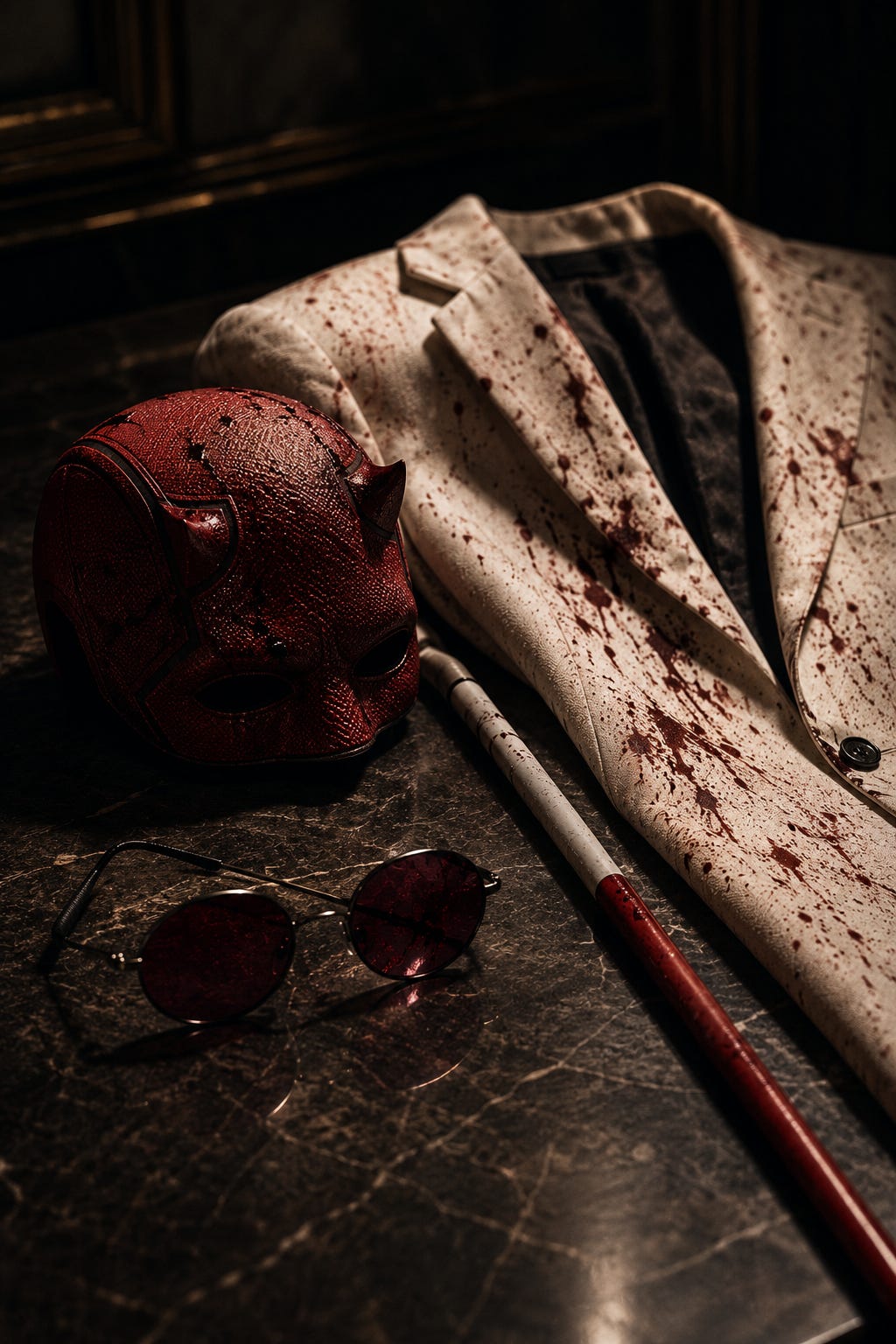
The season finale of Daredevil: Born Again, which aired on May 5, 2026, was the kind of episode that earns its runtime. Was it explosive? Yes. But what made it linger was something quieter running underneath all the action: an obsession with masks and what it means to finally take one off.
In superhero stories, the mask is usually treated as a practical necessity. Hide your face, protect the people you love, and keep your enemies from finding your front door. Simple enough. But there’s a more interesting reading that comic fans have debated for years that for many heroes, the costume isn’t the disguise at all. The ordinary life is. The civilian identity is the performance, and the hero beneath it is who they actually are.
This theme emerges explicitly in the episode when the psychologist, Dr. Heather Glenn, discusses the concept of masks during her testimony. She frames the idea in psychological terms, suggesting that individuals often construct identities to survive within society. This discussion foreshadows the first major climax of the episode.
The courtroom scene is the first major payoff. While cross-examining Wilson Fisk, Matt Murdock does something no one sees coming: he tells the room he’s Daredevil. Opposing counsel immediately objects, arguing that a blind man couldn’t possibly do what Daredevil does. Matt’s response is wordless. He folds his white cane and throws it across the room. It ricochets off the wall and comes straight back to his hand. The courtroom goes silent.
It’s a perfectly constructed moment, because it reframes everything we know about Matt. To the world, he’s always been the blind lawyer from Hell’s Kitchen inspiring, sympathetic, and physically vulnerable. Even Foggy, his closest friend, initially struggled to reconcile the Matt he knew with the man in the mask. That careful performance of limitation is what makes the reveal so striking. Daredevil was never the mask. Matt Murdock was.
Fisk gets his parallel moment in the second half of the episode, though his mask comes off very differently. As his grip on power starts to slip, with Vanessa gone and his political image crumbling he stops pretending. The mayor who spent a season telling New York he was its protector kicks down a door in his white suit and starts beating the people he claimed to love. There’s something almost relieving about it, in the darkest sense. The Kingpin was always there. Now everyone can see him.
When he steps onto the City Hall balcony and looks down at a crowd wearing Daredevil masks, he tries one last time to hold onto the narrative, accusing Daredevil of being the deceiver, insisting that his own cruelty came from love. Nobody’s buying it anymore. The crowd surges forward, and for a moment it looks like the city might tear itself apart.
That’s when Matt steps in not as Daredevil, but as himself. He pulls off his mask in front of everyone and stands face to face with Fisk, no costume between them, no symbols. Just two men and the city they’ve been fighting over. He asks Fisk to let it go. Somehow, in that stripped-down moment, Fisk does.
The episode could have ended there, on that note of resolution. Instead it saves its strangest beat for last. Dr. Glenn, who survived an attempt on her life by the killer known as Muse is shown quietly putting on Muse’s mask. After an hour of characters tearing their masks away, she’s putting one on. This scene doesn’t explain itself. It just sits there, unsettling and unresolved, suggesting that the story of who wears what face and why is far from over.
That's definitely one way to see it👏🏾