
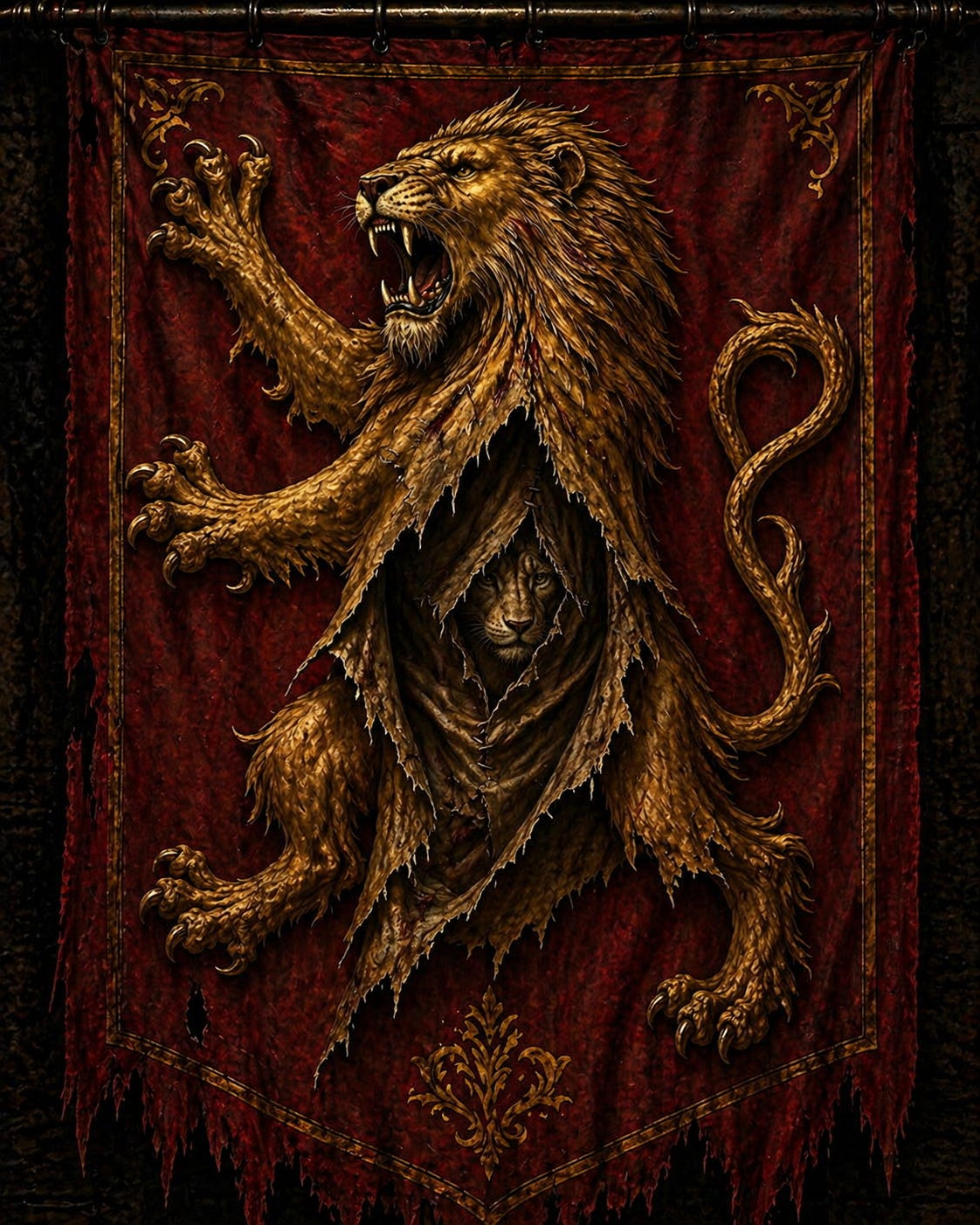
When we talk about intelligence in the world of Westeros, few names are invoked as quickly as Tywin Lannister. He is often presented as the archetype of calculated power, a master strategist whose every move is deliberate, precise, and necessary. But a closer examination suggests something different. This is less an analysis and more an assertion: Tywin Lannister is not the brilliant strategist he is made out to be. He is, more often than not, a brutal enforcer whose successes are built on fear rather than foresight.
To understand Tywin, it is important to briefly consider the origins of House Lannister itself. The house traces its legacy to Lann the Clever, a figure said to have gained control of Casterly Rock through trickery rather than conquest; various tales suggest deception, infiltration, or psychological manipulation. From the very beginning, then, the Lannister legacy is rooted not in honourable strength, but in cunning. The question, however, is whether cunning without restraint is meaningfully different from fraud.
By the time Tywin’s father, Tytos Lannister, ruled as Lord of Casterly Rock, the house had wealth but lacked authority. Tytos was widely seen as weak, and his bannermen exploited this weakness. Powerful houses such as the Reynes and the Tarbecks borrowed from the Lannisters and refused repayment, openly defying their liege. In Westeros, wealth without enforcement is meaningless.
Tywin’s rise begins here. As a young man, he did not negotiate, reform, or rebuild relationships; he annihilated opposition. He destroyed Houses Reyne and Tarbeck completely, wiping them out and sending a clear message to the realm: defiance would not be tolerated. The infamous legacy of this act, immortalized in “The Rains of Castamere,” established House Lannister’s dominance but it did so through terror, not diplomacy.
This pattern continues throughout his life.
During his tenure as Hand of the King under King Aerys II Targaryen, Tywin governed effectively on the surface. However, the Defiance of Duskendale reveals the limits of his approach. When Lord Denys Darklyn refused to pay taxes and demanded a charter, Tywin rejected the request outright. Defiance of Duskendale began when Darklyn escalated the conflict by inviting the king and then imprisoning him.
Contrary to the image of a decisive strategist, Tywin did not immediately resolve the crisis. Instead, he laid siege to the city for months because any direct assault would have resulted in the king’s death. His solution was not brilliance, it was stalemate. The situation was ultimately resolved not by Tywin, but by Ser Barristan Selmy, who rescued the king through a daring solo mission.
If anything, Duskendale exposes Tywin’s willingness to risk catastrophic consequences rather than adapt his methods. His instinct was force even when force was strategically unsound.
This same pattern is visible during Robert’s Rebellion. Tywin, once Hand of the King and a close ally of Aerys, did not immediately support the crown. Instead, he remained at Casterly Rock, waiting. Only when the outcome of the war was effectively decided did he march on King’s Landing. Under the guise of loyalty, he gained entry and then sacked the city, ordering the deaths of the royal family.
This is often framed as calculated opportunism. But it is equally fair to describe it as calculated cowardice avoiding risk until victory is assured, then claiming dominance through betrayal.
Even in moments where Tywin is credited with strategic success, the reality is more complex. At the Battle of the Blackwater, much of the defensive planning was executed by Tyrion Lannister. Tywin’s arrival with Tyrell forces secured victory, but he was quick to sideline Tyrion and claim the credit. This reinforces a consistent trait: Tywin does not merely exercise power; he controls the narrative of power.
Then there is the Red Wedding, arguably his most infamous act. In Westerosi culture, guest right is sacred, a tradition older than the kingdoms themselves. To violate it is to break one of the most fundamental laws of the land. Yet Tywin orchestrated the massacre of Robb Stark, his bannermen, and his allies under the protection of hospitality.
From a purely tactical standpoint, the move ended the war swiftly. But strategically, it came at a cost. It destroyed trust, destabilized alliances, and ensured that the North and much of the realm would never forget or forgive the betrayal. Even Tyrion, no stranger to pragmatism, questioned the long-term consequences.
Tywin’s justification “why is it more noble to kill ten thousand men in battle than a dozen at dinner?” reveals his philosophy. Efficiency over honour. Outcome over method. But this is precisely where the illusion of strategy begins to crack. True strategy considers long-term stability; brutality creates immediate results but lasting resentment.
To his credit, Tywin did achieve what he set out to do. Under his leadership, House Lannister became feared, respected, and politically dominant. The Westerlands were stable, and the family name carried weight across the realm.
But fear is not the same as loyalty. And power built on intimidation is inherently fragile.
In many ways, House Lannister under Tywin begins to resemble House Frey: cunning, opportunistic, and fundamentally untrustworthy. The only difference is history. The Lannisters possess ancient prestige; the Freys do not. Strip away that legacy, and the methods begin to look strikingly similar.
Which leads to a final question.
Does the lion concern himself with the opinion of the sheep?
Perhaps not.
But if the lion begins to act like one driven not by calculated dominance, but by reactive brutality then the distinction between them becomes less clear than he would like to believe.
Once again, a beautiful and mind opening piece